
Nose and eyes
Sneezing, runny or blocked nose, itchy eyes.
Health guide · Written by a medical technologist
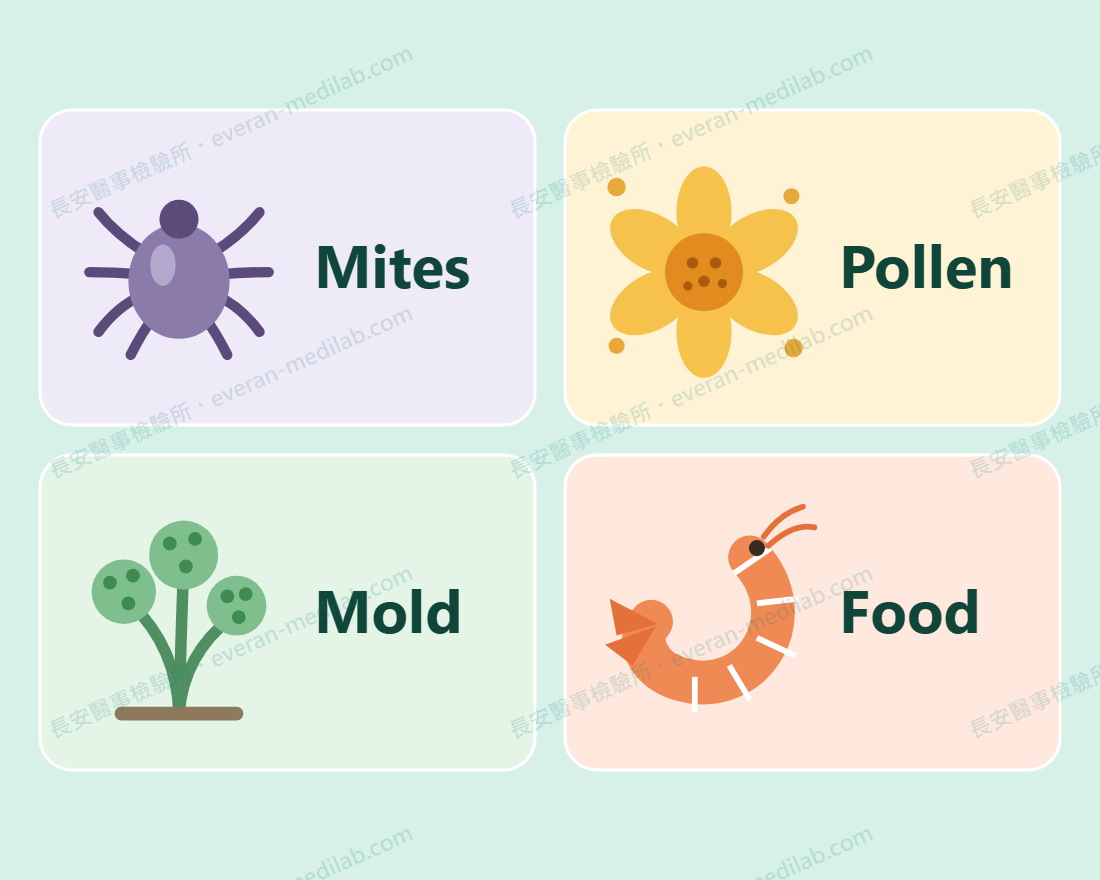
A reaction to dust mites, pollen or a food does not mean you have to avoid everything. This guide explains how allergy works, where allergens hide at home, how to read food labels, and how to adjust your diet step by step.
Want to see the panels first? Visit our allergy testing page.
WHAT IS ALLERGY
Your immune system is there to fight germs. In an allergy, it treats harmless things like pollen, dust mites or food as a threat, and reacts whenever you meet them.
On this page: IgE and IgG · At home · Food labels · Diet plan · Report classes · FAQ
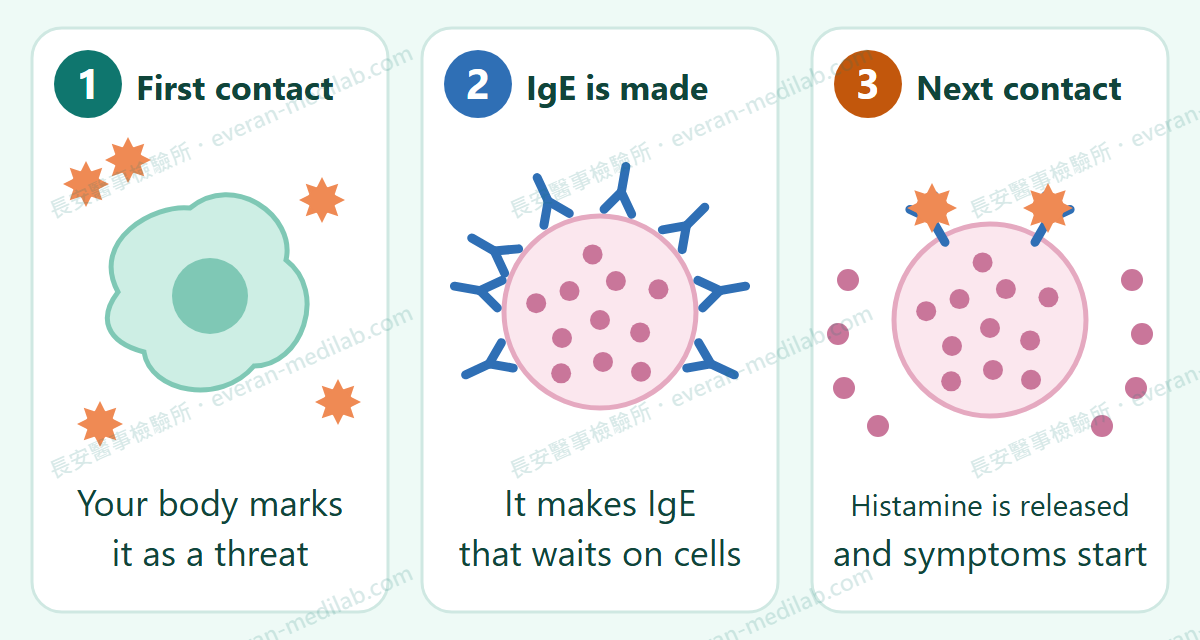
Sneezing, runny or blocked nose, itchy eyes.
Hives, itching, redness, tingling or swelling around the mouth.
Coughing, chest tightness, wheezing, asthma attacks.
Nausea, vomiting, stomach pain, diarrhea.
Call 119 right away if: after eating or a bee sting, your throat feels tight, you cannot breathe well, your lips or tongue swell, or you get a rash all over with dizziness or fainting. This may be anaphylaxis. Do not wait, and do not drive yourself to hospital.
IgE & IgG
You will often see both antibodies on your report. They mean different things and are used in different ways.
| Compare | IgE (immediate allergy) | Food IgG antibodies |
|---|---|---|
| When it appears | Usually minutes to 2 hours | Varies; some say 24–72 hours later, but the link with symptoms is still unclear |
| Common signs | Hives, runny nose, asthma, swollen lips | Tiredness, bloating, blocked nose, itchy skin, headaches; less clear-cut |
| What a result means | Your body has antibodies to it. It must match your symptoms to count as an allergy | Your body has antibodies to this food. Read it together with your symptoms |
| How to use it | Avoid it if it causes symptoms. See an allergist if you have had a severe reaction | One reference for adjusting your diet, not a diagnosis |
How we use IgG: as one reference for adjusting your diet, always together with your symptoms. We will never tell you to cut out foods from a number alone.
AT HOME
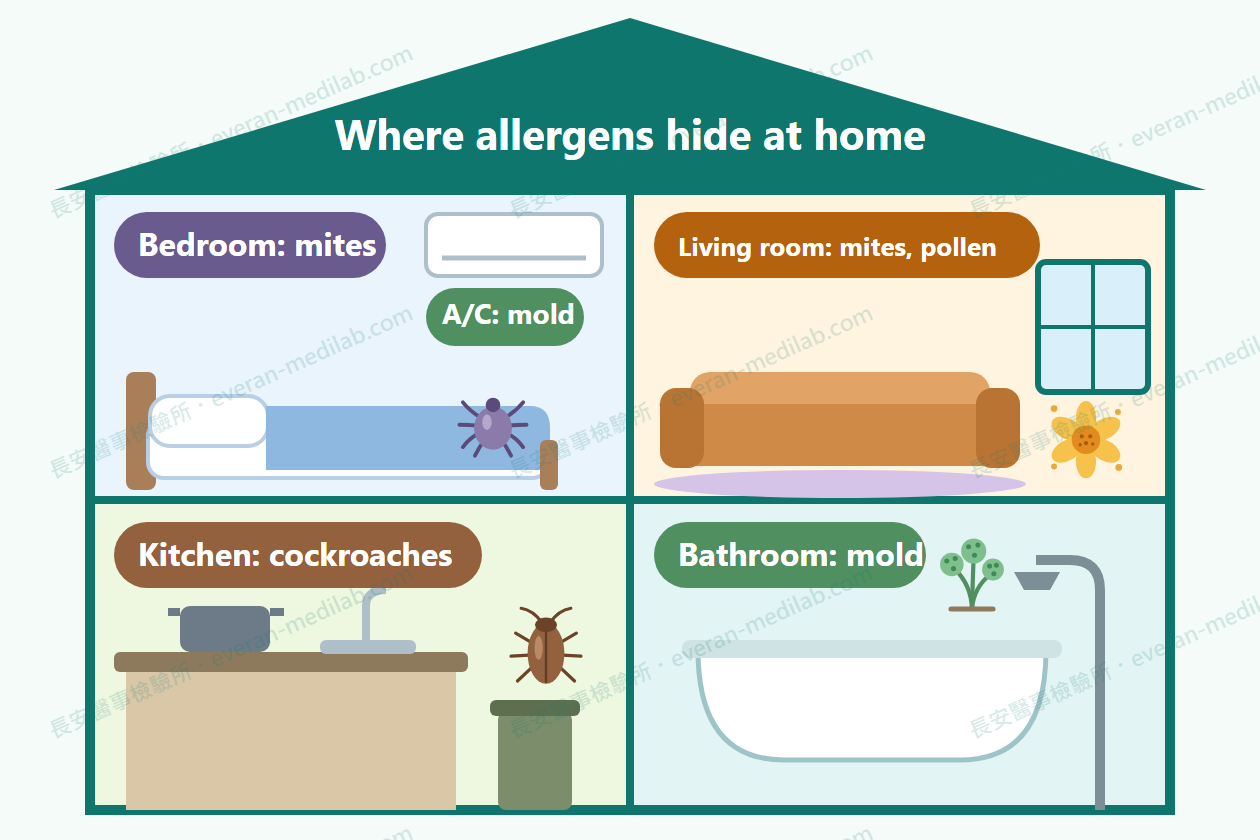
You cannot avoid environmental allergens completely, but you can reduce them. Start with the bedroom, where you spend the most time.
Beds, pillows, duvets, sofas, carpets
Tiny bugs you cannot see. They eat skin flakes and like warm, damp places. House dust mites and Blomia tropicalis are common in Taiwan. Their droppings and body parts mix into dust and are a common cause of nasal allergy and asthma.
Hot drying kills mites, but you still need to wash to remove the allergen.
Kitchens, bathrooms, drains, around bins
The allergens come from droppings, saliva, shed skin and dead bodies. Once dry, they mix into dust, float in the air and may trigger asthma.
Bathrooms, kitchens, A/C units, windows, basements
Mold grows wherever it is damp. Its spores are tiny and float in the air, and breathing them in may cause nasal allergy or asthma.
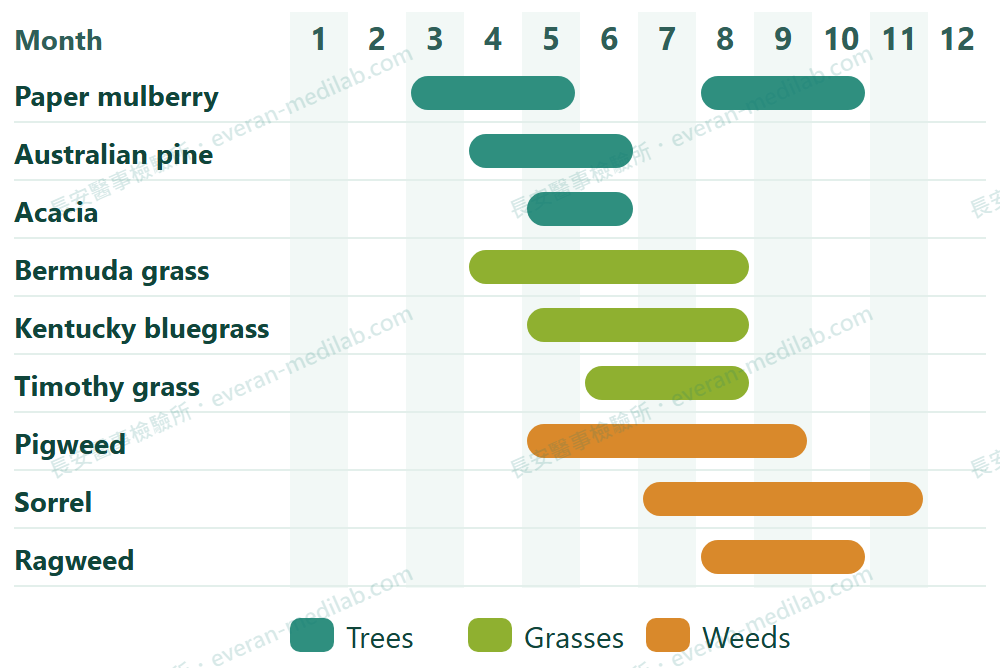
Outdoors, street trees, grassland, open ground
Taiwan is warm and plants flower for a long time, so there is pollen in the air for much of the year. Paper mulberry is a common source and is especially noticeable in spring.
FOOD
The easiest ones to miss are not the shrimp you can see, but what is in sauces, soup stock and processed food.
Check the label on packaged food. Taiwan requires packaged food to declare these 11 allergens: crustaceans, mango, peanuts, cow and goat milk, eggs, tree nuts, sesame, gluten grains, soy, fish and sulfites. Freshly made or loose food may not be labeled, so ask the seller when you order.
Main allergens: casein and whey.
Often found in: bread, cakes, cookies, pudding, ice cream, milkshakes, baked dishes, creamy soups.
Watch out: goat milk proteins are very similar, so if you are allergic to cow's milk you usually need to avoid goat milk too. Yogurt and cheese also contain milk protein.
Look for these words: egg white, egg yolk, albumin, ovalbumin, ovomucoid, egg powder.
Often found in: mayonnaise, salad dressing, tartar sauce, batter, pudding, cakes, cream puffs, dorayaki.
Watch out: egg white usually causes allergy more often than yolk.
Includes: shrimp, crab, clams, oysters, abalone, cuttlefish, squid, octopus.
Often found in: seafood stock, shrimp paste, Thai and Vietnamese dishes, kimchi, seafood rice.
Watch out: chitosan in supplements usually comes from shrimp and crab shells.
Local names: salmon is 鮭魚 or 三文魚, and tuna is 鮪魚 or 吞拿魚.
Do not mix them up: 扁鱈 is really halibut, and basa and dory are not cod either.
Watch out: if you are allergic to one fish, you may react to others. Do not test this yourself.
Peanuts are often in: Taiwanese spring rolls, gua bao, pig's blood cake, mochi, mala soup, Southeast Asian hot and sour noodles.
Sesame is often in: mala hot pot, mala soup, dipping sauces.
Watch out: peanuts are legumes, not tree nuts, so check them separately.
Wheat is often in: bread, noodles, cakes, cookies, beer.
Gluten: the main protein in wheat.
Watch out: despite its name, buckwheat is not related to wheat. Check them separately on your report.
Not fermented: soy milk, tofu, tofu skin.
Fermented: soy sauce, chili bean paste, miso, fermented tofu, natto.
Watch out: edamame and black soybeans are soy too, just a different variety or harvest time.
Pineapple and papaya: their enzymes are used to tenderize meat, clarify beer and in skincare.
Coconut: coconut milk and cream are used in Southeast Asian curry, green curry and laksa.
Mango: one of the allergens Taiwan requires on labels.
| Dish or seasoning | Common ingredients |
|---|---|
| Curry | Turmeric, black pepper, coriander, chili, clove, cinnamon, onion, garlic, ginger |
| Three-cup chicken, sesame oil chicken, clam soup | Ginger |
| Ginger duck (薑母鴨) | Dong quai, chuanxiong, astragalus, goji berry, ginger, cinnamon twig |
| Lamb hot pot (羊肉爐) | Dong quai, chuanxiong, astragalus, goji berry, ginger, licorice, cinnamon twig, star anise |
| Rice wine chicken (燒酒雞) | Dong quai, chuanxiong, goji berry, licorice, ginger, cinnamon twig |
| Herbal pork ribs (藥燉排骨) | Dong quai, chuanxiong, rehmannia, goji berry, black date, white peony root, cinnamon twig |
| Si Wu Tang (四物湯) | Dong quai, chuanxiong, rehmannia, white peony root |
| Si Shen Tang (四神湯) | Lotus seed, poria, fox nut, Chinese yam |
| Shi Quan Da Bu (十全大補) | Dong quai, chuanxiong, rehmannia, white peony root, ginseng, licorice, astragalus, atractylodes, poria, cinnamon |
NOT ALWAYS ALLERGY
Some reactions look like allergy but have a different cause and need different care.
This may be histamine poisoning. When fish is not fresh, bacteria make histamine. Cooking does not destroy it, and the symptoms look like allergy.
This may be lactose intolerance. You cannot digest lactose, but it is not an immune reaction. Consider it if your report shows no reaction to milk.
This may be physical irritation. Tiny calcium oxalate crystals in kiwi prick your mouth. If your lips swell or you wheeze, still see a doctor.
Your stomach may just be sensitive. Too much garlic can cause bloating and discomfort, and this is usually not allergy.
Not sure? Write down what you ate, how long it took, and what happened. Bring that and your report to the doctor.
DIET PLAN
An IgG report does not mean you must give up a long list of foods. Talk to a doctor or dietitian first, then work through these three stages.
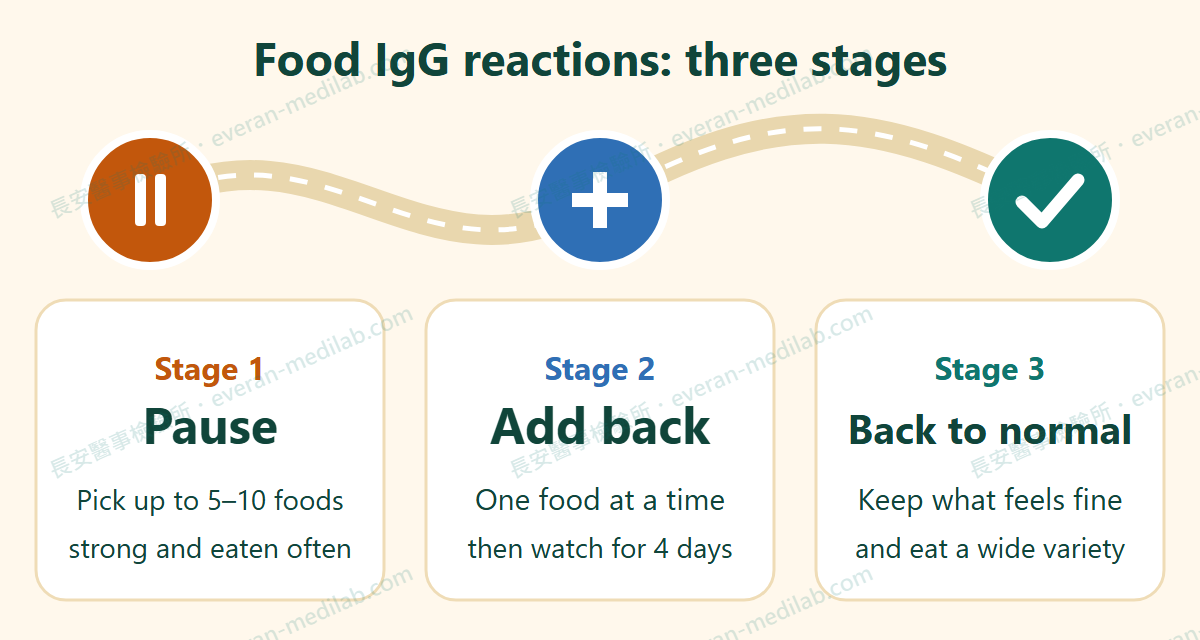
Choose up to 5–10 foods with stronger reactions that you eat often, and avoid hidden sources too. Staple foods that do not bother you can stay.
Once symptoms improve, try one food at a time: eat it 3 times over 2 days, then watch for 4 days. Use its simplest form, like plain milk rather than chocolate milk.
Foods that feel fine go back into your diet. Avoid those that do not for a while, then ask your doctor about trying again. Try not to eat the same food every day.
| IgG class | Diet advice on the report |
|---|---|
| Class 0 | Eat as normal |
| Class 1–2 (mild) | Generally fine, but avoid large amounts every day |
| Class 3–4 (moderate) | Pause for about 3 months, then eat at most once every 4 days |
| Class 5–6 (severe) | Pause for about 6 months, then once symptoms improve eat at most once every 4 days |
This table is the advice printed on the test maker's report. What you actually do depends on your symptoms. We usually suggest changing just a few foods, then coming back to talk after about 4–8 weeks, instead of cutting out too much at once.
Do not test these yourself: if a food has ever made your lips swell, made you wheeze or given you hives all over, never try it on your own. A specialist must arrange this. Children, pregnant or breastfeeding women and people who are underweight should also ask a doctor or dietitian before cutting out many foods.
HOW TO READ
These are the classes for E66, GE110, G101 and GE224. Quantitative panels like MAST, Q207 and A300 use different units and classes, so check the notes on your report.
| Class | Strength | IgE (a.u.) | IgG (a.u.) |
|---|---|---|---|
| 1 | Mild | 200–399 | 2,000–3,999 |
| 2 | Mild | 400–999 | 4,000–5,999 |
| 3 | Moderate | 1,000–1,999 | 6,000–11,999 |
| 4 | Moderate | 2,000–3,999 | 12,000–17,999 |
| 5 | Severe | 4,000–6,999 | 18,000–35,999 |
| 6 | Severe | ≥ 7,000 | ≥ 36,000 |
A high class does not always mean bad symptoms, and a low class does not mean you can relax. Read it with your symptoms.
Class 3 or above is usually treated as a likely allergen. Some doctors take note from class 2.
Antibodies can fall if you have not met an allergen for a long time. If something has caused an allergy before, keep avoiding it even if this test is negative.
FAQ
We do not recommend it. After a long time without contact, antibodies in your blood slowly fall, so the class may drop or even look normal. Your body still remembers the allergen, though, and you could react quickly. Please talk to an allergist first.
The cause may not be in the panel you took, such as a drug, a chemical or an item the panel does not cover. Some symptoms are not caused by allergy at all: temperature changes, air pollution and infections can feel similar.
Testing helps narrow things down, but it is not the only answer. If symptoms continue, take your report to a doctor.
Not always. Antibodies show your body recognizes something. It only counts as an allergy if contact actually causes symptoms. If shrimp shows a reaction but you have always eaten it without problems, talk to a doctor before cutting it out.
No. Avoiding too many foods for a long time can leave your diet unbalanced, especially for children. Start with a few foods, then decide what to do next based on your symptoms.
Keep indoor humidity around 50%, and no higher than 60%. This helps control both dust mites and mold. A small humidity meter in the bedroom is useful.
Sulfites are common food additives that stop browning and help food keep longer. They are often found in preserved fruit, dried lily flowers, pickled vegetables and some dried fruit. People with asthma are more likely to feel unwell from them, so check labels on packaged food.
They are not allergens that a test can find, but they may irritate your airways or nose. If they make you cough, feel blocked up or wheeze, have less of them.
PRICING
Prices are our current self-pay prices and may change. Not sure which to choose? Tell us your symptoms and budget.
| Panel | What it tests | Price |
|---|---|---|
| MAST 40 | Quantitative: 40 IgE items | Ask us |
| E66 | 66 IgE items | Ask us |
| GE110 | 66 IgE + 44 IgG items | Ask us |
| G101 | 101 IgG food items (the IgG part of GE224) | Ask us |
| GE224 | 123 IgE + 101 IgG items | Ask us |
| Q207 | Quantitative: 118 IgE + 89 IgG items | Ask us |
| A118 | Quantitative: 118 IgE items (the IgE part of Q207) | Ask us |
| F89 | Quantitative: 89 IgG food items (the IgG part of Q207) | Ask us |
| A300 | Quantitative: 300 IgE items | Ask us |
| F287 | Quantitative: 287 IgG items | Ask us |
| AF587 | A300 + F287 | Ask us |
See the full allergen list for each panel.